Mastering Image Resizing in Adobe Illustrator: A Comprehensive Guide for Stunning Visuals
Adobe Illustrator stands as a titan in the realm of vector graphics editors, a powerful platform that empowers both seasoned professionals and enthusiastic beginners to bring their most imaginative visual ideas to life. Renowned for its unparalleled precision and quality output, it’s an indispensable tool for graphic designers, digital artists, and photographers alike. While often associated with intricate vector artwork, Illustrator also offers robust capabilities for handling and resizing raster images, making it a versatile asset in any creative toolkit. On Tophinhanhdep.com, where we delve into everything from captivating wallpapers and high-resolution photography to advanced image tools and visual design insights, understanding the nuances of applications like Illustrator is paramount for creating truly impactful visuals.

Initially, Illustrator might appear daunting with its vast array of tools and functions. However, mastering fundamental operations like image resizing is surprisingly straightforward, especially with a clear, step-by-step guide. This article will demystify the process, exploring various methods to resize images effectively in Illustrator while preserving their integrity and quality. Whether you’re preparing images for web, print, or simply experimenting with digital art, these techniques will equip you to achieve perfect dimensions every time. We’ll cover everything from simple scaling to more advanced transformations, ensuring your visual content aligns perfectly with your creative vision, ready for any collection on Tophinhanhdep.com, be it aesthetic backgrounds or thematic collections.
Understanding Image Resizing in Adobe Illustrator: Vector vs. Raster
Before diving into the practical steps of resizing, it’s crucial to grasp a fundamental concept that differentiates Illustrator from pixel-based editors like Photoshop: the distinction between vector and raster graphics. This understanding is key to leveraging Illustrator’s strengths, particularly when it comes to maintaining image quality during scaling.

The Vector vs. Raster Distinction: Preserving Visual Integrity
Adobe Illustrator operates primarily in a vector environment. Vector graphics are composed of mathematical paths, lines, and curves defined by geometric points. This inherent mathematical nature means vector artwork can be scaled infinitely large or small without any loss in quality, resolution, or crispness. Logos, illustrations, and intricate graphic design elements are typically created as vectors because they need to be adaptable across various mediums, from a tiny favicon to a massive billboard, without becoming pixelated or blurry. This characteristic is especially valuable for Visual Design projects and when preparing elements for High Resolution Photography or Digital Photography where sharpness is paramount.
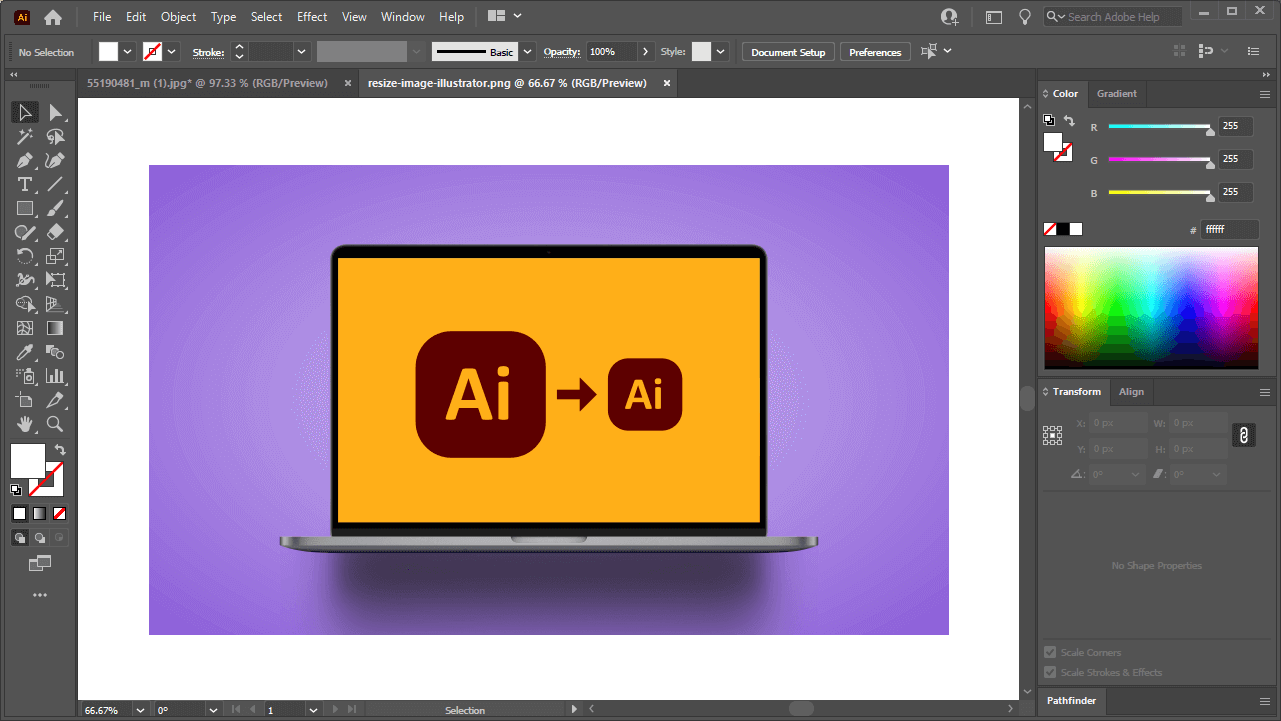
Raster images, on the other hand, are pixel-based. These are your standard photographs, scanned images, or graphics created in programs like Photoshop. They are composed of a grid of tiny colored squares (pixels). When you enlarge a raster image, the software has to “stretch” these existing pixels, often leading to a blocky, blurry, or “pixelated” appearance. This can severely detract from the aesthetic quality of wallpapers, backgrounds, or beautiful photography you might feature on Tophinhanhdep.com. While Illustrator can open and manipulate raster images, its vector-centric design means special considerations apply when resizing them to avoid undesirable quality degradation.
Why Resize Images in Illustrator? Essential Applications for Designers and Photographers
Resizing images is a fundamental task across virtually all digital and print design disciplines. In Illustrator, this action serves several critical purposes, catering to diverse needs ranging from professional graphic design to personal creative projects:
- Optimizing for Web and Digital Platforms: Websites, social media, and digital presentations often require images of specific dimensions to ensure fast loading times and optimal display across different devices. Resizing in Illustrator allows for precise control, helping to create crisp images that enhance the aesthetic appeal of any digital platform. This aligns perfectly with Tophinhanhdep.com’s focus on various image categories like Abstract or Nature wallpapers, ensuring they look stunning online.
- Preparing for Print Production: Print media, whether it’s brochures, posters, or custom labels, demands extremely high-resolution images with exact measurements. Illustrator’s ability to maintain vector integrity is invaluable here, ensuring that artwork for print remains sharp and professional, preventing common issues like pixelation that can ruin a physical product.
- Creating Uniformity in Visual Design: When compiling image collections, mood boards, or thematic layouts, consistent image sizing is crucial for a cohesive visual narrative. Illustrator provides the tools to standardize dimensions across multiple elements, contributing to a polished and professional look. This is vital for Photo Ideas and Trending Styles showcased on Tophinhanhdep.com.
- Photo Manipulation and Digital Art: Beyond simple scaling, Illustrator’s transform tools enable creative distortions, shaping, and precise placement of image elements within a larger composition. This flexibility supports complex Photo Manipulation and Digital Art projects, where an image might need to be resized, skewed, or warped to fit a unique artistic vision.
- Efficiency in Workflow: Knowing various resizing methods allows designers to choose the most efficient approach for each task, saving valuable time and effort in their daily workflow. This efficiency is a cornerstone of professional Graphic Design.
Ultimately, mastering image resizing in Illustrator ensures that every image, whether a high-resolution photograph or a subtle background, contributes positively to the overall visual impact, enhancing user experience and delivering professional-grade results across all your creative endeavors.
Core Methods for Resizing Images in Illustrator: Practical Approaches
Adobe Illustrator provides several intuitive methods for resizing images and objects, catering to different levels of precision and user preference. These techniques are designed to be straightforward, allowing you to quickly adapt your visuals to any project requirement.
Method 1: Precision with the Scale Tool (Object Menu)
This method offers a highly precise way to resize images using percentage-based scaling or exact numerical values, ensuring that your transformations are controlled and predictable.
- Launch Adobe Illustrator: Open the application on your computer.
- Open Your Image: Navigate to
File > Openand select the image file you wish to resize. Illustrator will place the image onto your artboard. For multi-part designs, ensure all elements you intend to scale together are selected or grouped. - Select the Image: Click directly on the image with the
Selection Tool(V) to select it. You’ll see a bounding box around the image. - Access the Scale Tool: Go to the top menu bar, click on
Object > Transform > Scale. This will open the Scale dialog box. - Set Your Desired Size:
- Uniform Scaling: To maintain the image’s original aspect ratio (proportions), select “Uniform.” Then, enter a percentage value (e.g., “50%” to reduce by half, “200%” to double) into the “Scale” field. This is generally recommended to avoid distorting the image, preserving the quality of your Beautiful Photography or aesthetic backgrounds.
- Non-Uniform Scaling: If you deliberately want to stretch or compress your image, select “Non-Uniform.” This allows you to set independent horizontal (H) and vertical (V) scale percentages. Be cautious with this option, as it can easily distort your image.
- Preview and Confirm: Check the “Preview” box within the Scale dialog to see the changes applied in real-time before committing. This allows you to adjust the percentage until you achieve the desired size. Once satisfied, click “OK” to apply the resize.
This method is ideal when you need to scale an image by a specific percentage, ensuring consistent and proportional resizing for your Visual Design projects.
Method 2: Direct Numerical Input via the Transform Panel
For users who prefer to work with exact measurements (e.g., inches, pixels, centimeters) or need to fine-tune dimensions, the Transform panel is an invaluable tool.
- Open Your Image and Select It: As in Method 1, open your image in Illustrator and select it using the
Selection Tool(V). - Open the Transform Panel: If the Transform panel isn’t visible, go to
Window > Transformto open it. Alternatively, you can often find a “Transform” option in the Control panel that appears at the top of your workspace when an object is selected. - Input Exact Dimensions: In the Transform panel, you’ll find “W” (Width) and “H” (Height) fields.
- Maintain Proportions: To lock the aspect ratio, click the chain icon located between the W and H fields. This ensures that when you change one dimension, the other adjusts automatically.
- Set Specific Values: Enter your desired width and/or height in the respective fields. Illustrator supports various units of measurement (e.g., “100px,” “5cm,” “2in,” “75%”). Simply type the number followed by the unit abbreviation.
- Apply Changes: Press
Enteron your keyboard after inputting the values. Your image will be resized immediately to the specified dimensions.
This method is particularly efficient for tasks requiring precise dimensions, such as preparing images for a specific layout in Graphic Design or ensuring uniform sizing for elements in a complex Digital Art piece.
Method 3: Dynamic Resizing with Bounding Box and Selection Tools
The most intuitive and frequently used method for quick adjustments involves directly manipulating the image on the artboard using its bounding box.
- Select the Image: Use the
Selection Tool(V) to click on your image. A bounding box with small white square handles (transformation handles) will appear around it. - Drag the Corners to Resize: Hover your cursor over one of the corner handles until the cursor icon changes to a straight two-way arrow.
- Maintain Aspect Ratio: Critically, hold down the Shift key while clicking and dragging a corner handle. This constrains the proportions, preventing accidental distortion of your image. This is essential for maintaining the integrity of your Photography and general image quality.
- Freehand Scaling: If you don’t hold Shift, you can freely stretch or compress the image horizontally, vertically, or diagonally, which can distort its proportions. Use this only when deliberate distortion is desired.
- Scaling from Center: To scale the image from its center point, hold down
Alt(Windows) orOption(Mac) in addition to Shift while dragging a corner handle.
- Adjust and Release: Drag the handle until the image reaches your desired visual size, then release the mouse button and the
Shiftkey.
While seemingly simple, this method is incredibly versatile for on-the-fly adjustments in any Visual Design project, from creating new backgrounds to arranging elements for photo manipulation. However, as noted in the original content, for raster images, simply dragging can lead to pixelation if enlarged beyond their original resolution. This brings us to a crucial technique for enhancing raster images.
Enhancing Raster Images for Better Scaling (Image Trace)
As discussed, enlarging a raster image will cause pixelation. Illustrator offers a powerful feature called “Image Trace” that can convert a raster image into vector artwork. This is a game-changer if you need to scale a raster image (especially logos or simple graphics) significantly without quality loss.
- Select Your Raster Image: Open and select the raster image you want to convert.
- Apply Image Trace: In the Control panel at the top of your screen (or by going to
Window > Image Trace), you’ll see an “Image Trace” option. Click the little triangle next to it to reveal presets. For photographs,High Fidelity Photois a good starting point, though it can be resource-intensive. For simpler images or logos,Black and White LogoorSketched Artmight be more appropriate. - Adjust Image Trace Settings (Optional): The Image Trace panel offers numerous settings to fine-tune the conversion, such as
Threshold,Paths,Corners, andNoise. Experiment with these to achieve the best vectorized result. - Expand the Traced Image: Once you’re happy with the preview, click the
Expandbutton in the Control panel (orObject > Image Trace > Expand). This converts the traced outline into editable vector paths and shapes. - Resize the Vectorized Image: Now that your image is vectorized, you can use any of the resizing methods above (Scale Tool, Transform Panel, or Bounding Box) to scale it infinitely without pixelation.
Important Note: While Image Trace works wonderfully for logos and simpler graphics, applying “High Fidelity Photo” to complex photographs, especially those with faces or intricate details, can sometimes result in a painterly, blurry, or overly stylized effect rather than a perfectly sharp, scalable photo. For such cases, the previous two methods (Scale Tool and Transform Panel) are generally preferred for initial resizing, or external AI Upscalers (as found on Tophinhanhdep.com’s Image Tools) might be a better solution if enlarging beyond the original resolution is critical while preserving photographic detail.
Advanced Resizing Techniques and Creative Transformations
Adobe Illustrator is more than just a tool for basic scaling; it’s a playground for creative transformations. Beyond simple resizing, you can use a variety of advanced techniques to reshape, distort, and manipulate images and objects, opening up new possibilities for graphic design and digital art.
Leveraging the Free Transform Tool for Dynamic Edits
The Free Transform tool (E) is a powerful, versatile instrument for dynamic adjustments, combining multiple transformation capabilities into one intuitive interface. It’s particularly useful for interactive and visually driven resizing.
- Select Your Object: Choose the image or object you want to transform using the
Selection Tool(V). - Activate Free Transform: Press
Eon your keyboard, or select it from the Tools panel. A bounding box with various transformation options will appear. - Explore Free Transform Modes: The Control panel at the top will present different modes for the Free Transform tool:
- Free Transform: The default mode, allowing you to scale, rotate, and skew by dragging handles.
- Constrain: When enabled (often by clicking the chain icon or holding Shift), this mode maintains proportions during scaling and rotation.
- Free Distort: This mode allows you to freely drag the corner handles to distort the shape in any direction, ideal for perspective effects or unique creative ideas.
- Perspective Distort: This mode applies a perspective effect, useful for making objects appear to recede into the distance or creating depth in your compositions.
- Free Transform (from center): Holding
Alt(Windows) orOption(Mac) while dragging will transform the object from its center point.
The Free Transform tool is excellent for Photo Manipulation, allowing you to quickly adjust the visual flow and composition of elements within your artwork.
Transforming Multiple Objects with “Transform Each”
Sometimes, you need to apply the same transformation (like scaling) to several objects independently, rather than scaling them all as a single unit. The “Transform Each” command is perfect for this, offering immense control for complex layouts or Image Collections.
- Select Multiple Objects: Use the
Selection Tool(V) to select all the individual objects you wish to transform. - Access Transform Each: Go to
Object > Transform > Transform Each. This opens a dialog box. - Apply Independent Transformations: Within the
Transform Eachdialog, you can setScale(Horizontal and Vertical),Move(Horizontal and Vertical), andRotatevalues.- Scale: Enter percentage values for scaling. Check “Random” if you want each selected object to be scaled by a random amount within the specified range, adding a natural variation to your collection of elements.
- Reflect: You can also
Reflect X(flip horizontally) orReflect Y(flip vertically) for each object. - Preview: Enable the
Previewcheckbox to see the effect of your settings in real-time.
- Confirm Changes: Once you are satisfied with the individual transformations, click
OK.
This method is a time-saver for Visual Design tasks that involve repeating elements, such as generating unique patterns for backgrounds or arranging numerous smaller aesthetic images where each needs independent, yet consistent, modification.
Artistic Distortions: Shear and Envelop Distort
Beyond simple scaling, Illustrator offers tools that allow for artistic distortions, enabling you to add dynamic effects and unique styling to your images and objects. These tools are fantastic for Digital Art and creative photo manipulation.
The Shear Tool
The Shear tool is used to slant or skew objects, creating a “shearing” effect. This is particularly useful for casting shadows or creating a sense of motion.
- Select Your Object: Select the image or object.
- Access the Shear Tool: You can find it by long-clicking the
Scale Toolin the Tools panel, or by going toObject > Transform > Shear. - Set Shear Angle: In the
Sheardialog box, enter aShear Angleto define the degree of slanting. You can also specify theAxis(Horizontal, Vertical, or Angle) along which the shear will occur. - Preview and Apply: Use the
Previewcheckbox to see the effect before clickingOK.
Envelop Distort
Envelop Distort allows you to reshape objects and images by fitting them into a predefined shape or “envelope.” This can create complex and organic distortions.
- Create Your Envelope Shape: First, draw the shape you want your image to conform to (e.g., an arc, a flag, a squeeze, or a custom shape). Place this shape on top of your image.
- Select Both: Select both your image (the object to be distorted) and the envelope shape.
- Make with Top Object: Go to
Object > Envelop Distort > Make with Top Object. Illustrator will fit your image into the shape of the top object. - Make with Warp: Alternatively, you can use
Object > Envelop Distort > Make with Warpto choose from a variety of preset warp styles likeArc,Flag,Wave,Squeeze,Twist,ZigZag,Pucker & Bloat, orRoughen. These are excellent for generating creative effects and unique visual elements for your Digital Art projects or thematic collections on Tophinhanhdep.com.
These advanced tools push the boundaries of simple resizing, allowing artists to transform images into dynamic components that enhance the overall visual narrative and aesthetic impact of their work.
Optimizing Your Workflow and Exporting Resized Images
Effectively resizing images in Illustrator is only part of the process. A complete workflow involves setting up your environment for efficiency and, crucially, knowing how to properly export your resized images for their intended final use. This ensures that the effort put into resizing translates into high-quality output, whether for web display, print, or integration into other projects.
Setting Up Your Workspace: Units of Measurement and Grouping Artwork
A well-organized workspace and thoughtful preparation can significantly streamline your resizing tasks and prevent common errors.
Setting Units of Measurement
Working with the correct units of measurement from the outset is vital for precision, especially when collaborating or preparing for specific output mediums.
- Access Rulers: You can quickly display rulers by pressing
Ctrl + R(Windows) orCmd + R(Mac). These appear along the top and left sides of your artboard. - Change Units: Right-click directly on either of the rulers. A context menu will appear, allowing you to select your desired unit (e.g., Pixels, Inches, Millimeters, Centimeters, Picas, Points). All subsequent measurements in Illustrator, including those in the Transform panel, will reflect this choice.
- Document Setup: Alternatively, you can change the units for the entire document via
File > Document Setup. This ensures consistency across your project, which is important for professional Graphic Design and Photography work.
Selecting and Grouping Artwork
When dealing with multiple elements that form a single visual piece (like a logo with text, or an illustration composed of several shapes), grouping them before resizing is critical to maintain their relative proportions and arrangement.
- Select All Components: Use the
Selection Tool(V) to click and drag a marquee around all parts of the artwork you want to scale together. - Group the Elements: Right-click on any selected object and choose
Groupfrom the context menu, or use the shortcutCtrl + G(Windows) /Cmd + G(Mac). - Benefits of Grouping: Grouping combines the selected items into a single logical “object.” Now, when you resize this group, all internal elements scale proportionately, ensuring your design remains cohesive and visually correct. This is crucial for avoiding skewed text or distorted graphic elements when preparing for print or web.
This preparatory step is a cornerstone of efficient Visual Design, ensuring that your compositions, whether for Tophinhanhdep.com’s aesthetic collections or complex digital art, scale harmoniously.
Exporting Your Resized Artwork for Various Uses
Once your image or artwork is perfectly resized in Illustrator, the final step is to export it in a usable format for its intended purpose. Illustrator offers robust export options tailored for different media.
- Select the Artwork for Export: Use the
Selection Tool(V) to select the resized image or grouped artwork you wish to export. - Open Export for Screens: Right-click on the selected artwork and choose
Export Selection.... This will open the “Export for Screens” dialog box, which is a powerful tool for preparing assets. - Configure Export Settings:
- Name: Rename your asset from the default “Asset 1” to something descriptive.
- Export To: Click the folder icon to specify the destination folder on your computer.
- Formats: This crucial section allows you to define output parameters:
- Scale: For exporting the image at its current, resized dimensions, set this to
1x. If you need multiple versions (e.g., for different device resolutions), you can add scales like2x,3x, or custom widths/heights. - Suffix: Add a suffix (e.g., “@2x”) to the filename for scaled versions.
- Format: Choose the appropriate file format:
- PNG: Ideal for images with transparency (like logos or icons) or when high quality with lossless compression is desired. Excellent for web elements and high-resolution photography.
- JPG: Best for complex photographs or images without transparency, offering good compression with adjustable quality. Useful for backgrounds, wallpapers, and general image content on Tophinhanhdep.com.
- SVG: Specifically for vector graphics, offering infinite scalability without quality loss. Perfect for web logos and illustrations.
- PDF: Suitable for print-ready files or documents that need to retain vector data and high quality.
- Scale: For exporting the image at its current, resized dimensions, set this to
- Export the Asset(s): After configuring all settings, click the
Export Assetbutton. Your resized image will be saved to the specified location in the chosen format(s).
This export process is integral to making your resized images production-ready. By understanding the optimal format and scale settings, you can ensure that your visuals maintain their high quality and are perfectly optimized for their final destination, whether it’s for a website’s image gallery, a print campaign, or for sharing as inspiring photography on platforms like Tophinhanhdep.com. This attention to detail in the export stage complements the sophisticated resizing capabilities of Illustrator, ensuring a complete and professional visual design workflow.
Conclusion
Adobe Illustrator, despite its sophisticated vector-graphic capabilities, proves to be an exceptionally versatile and user-friendly tool for resizing images. From the simplest drag-and-drop actions to precise numerical inputs and complex creative distortions, Illustrator equips you with an arsenal of methods to achieve perfect image dimensions. Its inherent ability to handle vector artwork means that your designs can scale infinitely without loss of quality, a critical advantage for Graphic Design, Digital Art, and High-Resolution Photography. While raster images require a bit more consideration, techniques like Image Trace can bridge the gap, converting pixel-based visuals into scalable vectors.
Mastering these resizing techniques is more than just about changing dimensions; it’s about gaining control over your visual narratives, ensuring every image serves its purpose with clarity and impact. Whether you’re curating stunning wallpapers, preparing aesthetic backgrounds for web, or fine-tuning elements for photo manipulation, Illustrator’s tools empower you to achieve professional-grade results. This understanding is invaluable for anyone passionate about visual content, from contributing to the vast Image Inspiration & Collections on Tophinhanhdep.com to crafting personal projects that reflect your unique creative ideas.
Don’t be afraid to experiment with the various tools – the Scale tool, Transform panel, Free Transform, Shear, and Envelop Distort all offer unique avenues for creative expression. With this comprehensive guide, you are now well-equipped to tackle image resizing in Illustrator, transforming your daily routine into an opportunity to create real masterpieces. Embrace the journey of learning, and let Illustrator be your canvas for endless creative possibilities, enhancing every image you touch for a truly successful visual presence in your work and on platforms like Tophinhanhdep.com.